- Contents in this wiki are for entertainment purposes only
7400 Family Truth Tables: Difference between revisions
Jump to navigation
Jump to search
XenoEngineer (talk | contribs) No edit summary |
XenoEngineer (talk | contribs) No edit summary |
||
| Line 4: | Line 4: | ||
[[Category:reference]] | [[Category:reference]] | ||
;Basic logic gates are fundamental building blocks of digital circuits, performing logical operations on binary inputs to produce a single binary output. | ;Basic logic gates are fundamental building blocks of digital circuits, performing logical operations on binary inputs to produce a single binary output. | ||
==Logic Gates Truth Tables== | ;The seven basic logic gates are''':''' | ||
===Logic Gates Truth Tables=== | |||
<html> | <html> | ||
<style> | <style> | ||
| Line 15: | Line 14: | ||
th, td { border: 1px solid black; padding: 8px; text-align: center; } | th, td { border: 1px solid black; padding: 8px; text-align: center; } | ||
th { background-color: #f2f2f2; } | th { background-color: #f2f2f2; } | ||
.left-table { float: left; margin | .left-table { float: left; margin:0 40px; } | ||
.right-table { | .right-table { zfloat: right; margin-right: 30% ; } | ||
.zero { background-color: lime; } | .zero { background-color: lime; } | ||
.one { background-color: orange; } | .one { background-color: orange; } | ||
</style> | </style> | ||
<br style="clear:both;"/> | |||
<div class="left-table"> | <div class="left-table"> | ||
<h3>Buffer</h3> | <h3>Buffer</h3> | ||
<table> | <table> | ||
<tr> | <tr><th>Input</th> | ||
<th>Output</th></tr> | |||
<tr><td class="zero">0</td> | |||
<td class="zero">0</td></tr> | |||
<tr> | <tr><td class="one">1</td> | ||
<td class="one">1</td></tr> | |||
<tr> | |||
</table> | </table> | ||
</div> | </div> | ||
<div class="right-table"> | <div class="right-table"> | ||
<h3> | <h3>NOT Gate</h3> | ||
<table> | <table> | ||
<tr> | <tr> | ||
| Line 56: | Line 48: | ||
</table> | </table> | ||
</div> | </div> | ||
<br style="clear:both;"/> | <br style="clear:both;"/> | ||
<div class="left-table"> | <div class="left-table"> | ||
| Line 88: | Line 79: | ||
</table> | </table> | ||
</div> | </div> | ||
<div class="right-table"> | <div class="right-table"> | ||
<h3>NAND Gate</h3> | <h3>NAND Gate</h3> | ||
| Line 120: | Line 110: | ||
</div> | </div> | ||
<br style="clear:both;"/> | <br style="clear:both;"/> | ||
<div class="left-table"> | <div class="left-table"> | ||
<h3> | <h3>OR Gate</h3> | ||
<table> | <table> | ||
<tr> | <tr> | ||
| Line 147: | Line 136: | ||
<td class="one">1</td> | <td class="one">1</td> | ||
<td class="one">1</td> | <td class="one">1</td> | ||
<td class=" | <td class="one">1</td> | ||
</tr> | </tr> | ||
</table> | </table> | ||
</div> | </div> | ||
<div class="right-table"> | <div class="right-table"> | ||
<h3> | <h3>NOR Gate</h3> | ||
<table> | <table> | ||
<tr> | <tr> | ||
| Line 178: | Line 166: | ||
<td class="one">1</td> | <td class="one">1</td> | ||
<td class="one">1</td> | <td class="one">1</td> | ||
<td class=" | <td class="zero">0</td> | ||
</tr> | </tr> | ||
</table> | </table> | ||
<br style="clear:both;"/> | <br style="clear:both;"/> | ||
<div class="left-table"> | <div class="left-table"> | ||
<h3> | <h3>XOR Gate</h3> | ||
<table> | <table> | ||
<tr> | <tr> | ||
| Line 210: | Line 196: | ||
<td class="one">1</td> | <td class="one">1</td> | ||
<td class="one">1</td> | <td class="one">1</td> | ||
<td class=" | <td class="zero">0</td> | ||
</tr> | </tr> | ||
</table> | </table> | ||
</div> | </div> | ||
<div class="right-table"> | <div class="right-table"> | ||
<h3> | <h3>XNOR Gate</h3> | ||
<table> | <table> | ||
<tr> | <tr> | ||
| Line 241: | Line 226: | ||
<td class="one">1</td> | <td class="one">1</td> | ||
<td class="one">1</td> | <td class="one">1</td> | ||
<td class=" | <td class="one">1</td> | ||
</tr> | </tr> | ||
</table> | </table> | ||
</div> | </div> | ||
</html> | </html> | ||
https://learnabout-electronics.org/Digital/images/basic-gate-ICs.gif | |||
;<small>Image linked from [https://learnabout-electronics.org/<big>'''learnabout-electronics.org'''</big>]</small> | |||
<br style="clear:both;"/> | <br style="clear:both;"/> | ||
| Line 261: | Line 249: | ||
:[4] http://www.markbereit.com/rsrc/ccdig_74ls.html | :[4] http://www.markbereit.com/rsrc/ccdig_74ls.html | ||
:[5] https://en.wikipedia.org/wiki/7400-series_integrated_circuits | :[5] https://en.wikipedia.org/wiki/7400-series_integrated_circuits | ||
Latest revision as of 18:04, 26 February 2024
- Basic logic gates are fundamental building blocks of digital circuits, performing logical operations on binary inputs to produce a single binary output.
- The seven basic logic gates are:
Logic Gates Truth Tables
Buffer
| Input | Output |
|---|---|
| 0 | 0 |
| 1 | 1 |
NOT Gate
| Input | Output |
|---|---|
| 0 | 1 |
| 1 | 0 |
AND Gate
| A | B | Output |
|---|---|---|
| 0 | 0 | 0 |
| 0 | 1 | 0 |
| 1 | 0 | 0 |
| 1 | 1 | 1 |
NAND Gate
| A | B | Output |
|---|---|---|
| 0 | 0 | 1 |
| 0 | 1 | 1 |
| 1 | 0 | 1 |
| 1 | 1 | 0 |
OR Gate
| A | B | Output |
|---|---|---|
| 0 | 0 | 0 |
| 0 | 1 | 1 |
| 1 | 0 | 1 |
| 1 | 1 | 1 |
NOR Gate
| A | B | Output |
|---|---|---|
| 0 | 0 | 1 |
| 0 | 1 | 0 |
| 1 | 0 | 0 |
| 1 | 1 | 0 |
XOR Gate
| A | B | Output |
|---|---|---|
| 0 | 0 | 0 |
| 0 | 1 | 1 |
| 1 | 0 | 1 |
| 1 | 1 | 0 |
XNOR Gate
| A | B | Output |
|---|---|---|
| 0 | 0 | 1 |
| 0 | 1 | 0 |
| 1 | 0 | 0 |
| 1 | 1 | 1 |
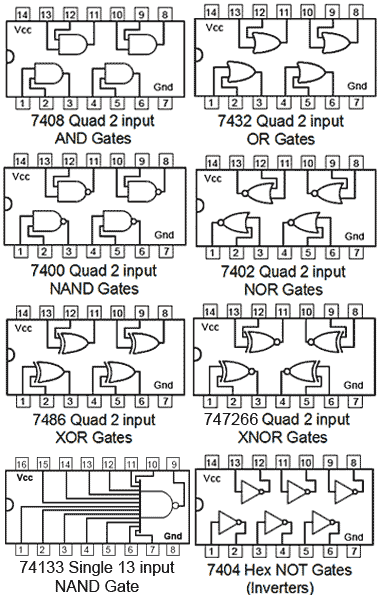
- Image linked from learnabout-electronics.org
Tri-state outputs (for multiplexing outputs)
- Retrieved 11:23, 26 February 2024 (UTC) from Perplexity.io
In a 7400-series integrated circuit, the main difference between a tri-state output and a regular output lies in the ability of the tri-state output to assume three states: high (logic 1), low (logic 0), or a high-impedance state (open circuit). This allows the output to be effectively disconnected from the rest of the circuit when not actively driving a signal. Tri-state outputs require an additional "enable" input to control whether the output is active or in the high-impedance state, providing flexibility in signal routing and preventing short circuits when multiple devices are connected to the same output line[1][3]. Regular outputs, on the other hand, typically drive signals actively without the option to disconnect from the circuit.
The tri-state output's ability to enter a high-impedance state makes it particularly useful in scenarios where multiple devices share a common output line, allowing only one device to drive the signal at a time while others remain disconnected, thus preventing signal contention and ensuring proper communication within the circuit[3].
Citations
- [1] https://www.electronics-notes.com/articles/electronic_components/logic-ic-families-technologies/7400-series-ttl.php
- [2] https://youtube.com/watch?v=OgV4tDxk7sY
- [3] https://forum.digikey.com/t/tri-state-logic-input-outputs/25183
- [4] http://www.markbereit.com/rsrc/ccdig_74ls.html
- [5] https://en.wikipedia.org/wiki/7400-series_integrated_circuits